
What if the real patient in our healthcare system isn’t you or me—but the country itself?
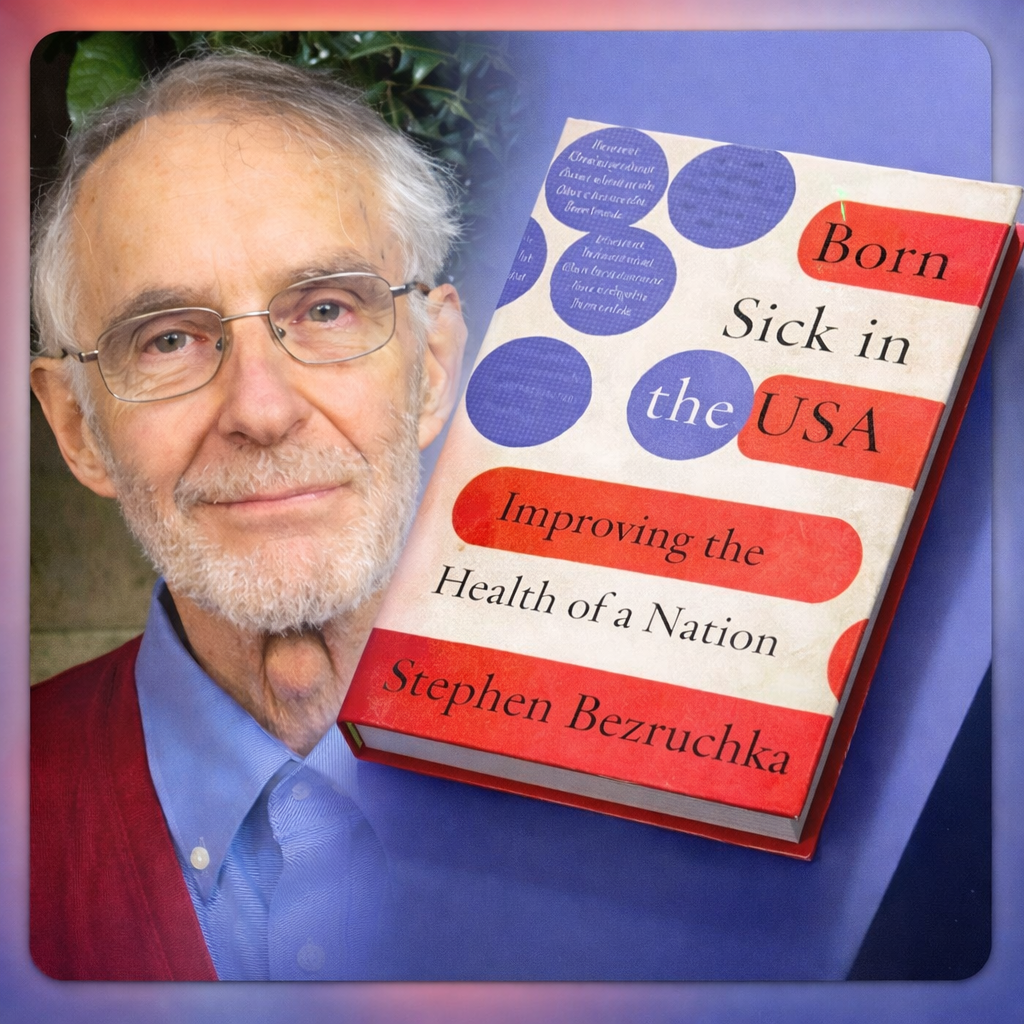
That’s the question I opened with when I sat down with Dr. Steven Bezruchka on the KSVY Morning Show, and it’s the one that stayed with me long after the microphones were off.
Dr. Bezruchka, author of Born Sick in the USA: Improving the Health of a Nation, makes a striking argument: Americans are sicker than people in other wealthy nations—not because of our individual choices, not because we’re failing to eat right or exercise enough—but because of the conditions we’re born into and the society we’ve built together.
That’s a big shift.
We’re used to thinking about health as personal responsibility. Take the right supplements. Eat the right foods. Get your steps in. Optimize your routine.
But what if that’s not where the real story is?
The First 1,000 Days
One of the most powerful insights from our conversation is just how much of our health is shaped before we even have a say in it.
Dr. Bezruchka points to the first 1,000 days—from conception through early childhood—as the period where roughly half of our adult health is “programmed.”
And here’s where the United States falls behind.
Unlike most wealthy nations, we don’t guarantee paid leave for new mothers. We don’t consistently support early life in the way healthier countries do. That means, from the very beginning, many Americans are starting from a disadvantage.
You can do everything “right” later in life—but if you’re already behind at the starting line, it’s hard to catch up.
Inequality Isn’t Just Economic—It’s Deadly
If early life is one pillar, inequality is the other.
Dr. Bezruchka doesn’t mince words here: inequality kills.
There are hundreds of studies linking income and wealth inequality to worse health outcomes. The more unequal a society becomes, the shorter and less healthy people’s lives tend to be.
And the United States? We’re one of the most unequal—and increasingly so.
What’s striking is that this affects everyone.
Even the wealthiest Americans are less healthy than their counterparts in other wealthy nations. That’s how powerful the system-level effects are. This isn’t just about poverty—it’s about the structure of society itself.
Healthcare Isn’t the Same as Health
Here’s another reframe that really landed for me.
We talk constantly about healthcare—access, insurance, costs—as if that’s the same thing as health.
It’s not.
According to Dr. Bezruchka, healthcare accounts for maybe 10% of health outcomes.
The other 90%?
That comes from social conditions—early life, stress, inequality, environment.
And yet, the United States spends more on healthcare than any country in the world. Nearly half of global healthcare spending happens here.
So the question becomes: if we’re spending the most, why aren’t we the healthiest?
Because we’re treating symptoms, not causes.
A Stressed-Out Nation
One of the more sobering parts of the conversation was around stress and mental health.
We are, by many measures, one of the most stressed countries in the world. We consume a disproportionate share of psychiatric medications and opioids, while still experiencing rising rates of mental illness and suicide.
Instead of asking why demand is so high, we often focus on controlling supply.
But the deeper issue, as Dr. Bezruchka frames it, is the environment we’re living in—the pressure, the inequality, the instability.
In other words, the system is making us sick.
So What Do We Do?
If the country is the patient, then the treatment isn’t just individual—it’s collective.
Dr. Bezruchka points to policy-level changes: reducing inequality, investing in early life, rethinking how resources are distributed.
But he also offers something more immediate.
Talk about it.
Develop what he calls an “elevator speech.” Learn how to explain these ideas simply, clearly, and share them—with friends, with coworkers, even with the next telemarketer who calls your phone.
Because change doesn’t just happen through policy.
It happens through conversation.
Listen to the Full Conversation
We covered a lot more ground in this interview—from mental health to the political economy of healthcare.
If there’s one takeaway, it’s this:
Health isn’t just something we manage individually.
It’s something we create collectively.
And right now, we’ve got some work to do.