
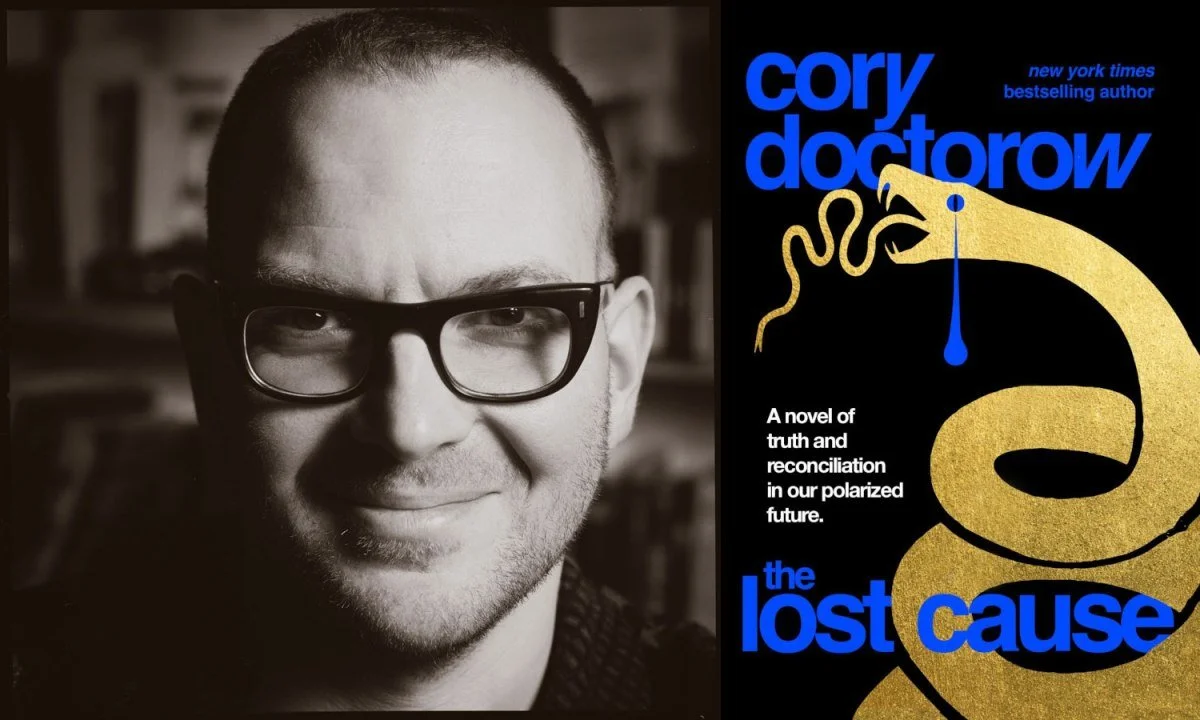
When I sat down with Cory Doctorow on KSVY Sonoma 91.3 FM, the conversation ranged far—copyright, artificial intelligence, platform power, and the slow unraveling of the systems that shape our digital lives.
But at the center of it all was his novel, The Lost Cause.
At the time of our conversation in December 2023, the book felt like near-future speculation—a story imagining what comes after a major political rupture, after a moment where things don’t go the way we hope.
Now, in 2026, it feels a lot less like speculation.
It feels like we’re already inside it.
A Story About What Comes After
The Lost Cause isn’t a dystopian collapse story.
It’s something more grounded—and in some ways, more unsettling.
It starts from a premise that feels uncomfortably familiar: a political failure, a system pushed to its limits, a society forced to reckon with what comes next.
But instead of ending there, Doctorow pushes forward.
The book asks a different question:
What happens after?
Not just how things break—but how people rebuild. How communities reorganize. How systems that failed get reimagined, or replaced, or resisted.
It’s not about despair.
It’s about process.
The Systems Behind the Story
What makes the book hit harder is how closely it connects to the real-world systems we’re living in.
In our conversation, Cory didn’t separate fiction from reality—he bridged them.
He talked about how copyright law has expanded far beyond its original purpose. How tools that were meant to protect creators are now often used in ways that benefit large institutions more than individuals.
He unpacked the confusion around AI—how much of the public debate is focused on the wrong questions, while the real issues around labor, ownership, and power go unaddressed.
And he returned, again and again, to the role of monopoly.
Because when power concentrates, it doesn’t matter what tool you’re talking about—copyright, platforms, AI—the outcome tends to look the same.
Control moves upward.
Access narrows.
And the people doing the creative work are left trying to navigate a system that wasn’t built for them.
From Theory to Lived Experience
Listening back to that conversation now, what stands out is how much of it has already played out.
The acceleration of AI.
The continued consolidation of media.
The erosion of trust in institutions.
None of it feels abstract anymore.
And that’s where The Lost Cause lands differently.
It’s not predicting the future.
It’s describing a phase we’re already moving through.
A moment where the old systems are still in place—but clearly not working the way they once did, if they ever did.
Why This Conversation Matters
What I appreciated about sitting down with Cory is that he doesn’t stop at critique.
He points toward alternatives.
Open systems.
Collective action.
New ways of thinking about ownership, collaboration, and participation.
That doesn’t mean easy solutions.
It means acknowledging that the structures we’ve built are not fixed—and that change, while difficult, is possible.
Listen to the Full Conversation
We covered a lot of ground in this interview—from The Lost Cause to AI, copyright, and the future of the internet.
If you want to go deeper, you can listen to the full conversation here:
And to explore more of Cory’s work, visit his website:
The Lost Cause asks what happens after a failed revolution.
Right now, that doesn’t feel like a distant question.
READ THE BOOK.